
- (08) 6182 4916
- admin@frametec.com.au
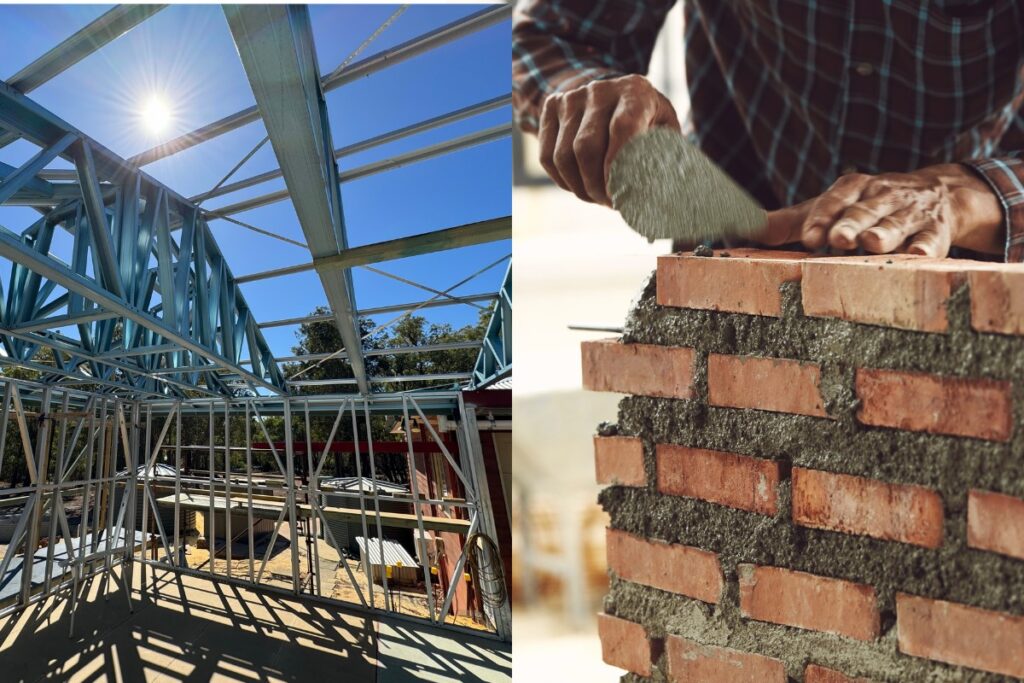
For generations, Western Australia has been known as the home of double-brick construction. Unlike most other Australian states, where timber or steel framing has long been the standard, WA homeowners have traditionally preferred solid masonry homes.
Today, however, the residential construction industry is experiencing one of its biggest shifts in decades.
While brick remains an important part of home construction, more builders are adopting framed construction methods, especially steel framing combined with brick veneer or lightweight cladding. It reduces build times, improves efficiency while tackling ongoing labour and supply challenges head on.
This smarter combination of materials allows builders to deliver homes faster while maintaining the appearance and durability that Western Australian buyers expect.
Perhaps the biggest challenge facing WA builders is not materials, but skilled labour.
Traditional double-brick construction requires multiple specialised trades to work sequentially:
Each trade becomes another potential delay.
Framed construction removes much of this dependency. Wall frames are manufactured off-site under controlled conditions before being delivered ready for installation, allowing builders to close in a house significantly sooner.
With skilled bricklayers continuing to be in short supply, builders are increasingly looking for methods that reduce reliance on large bricklaying crews.
Time has become one of the most valuable commodities in residential construction.
Recent industry commentary suggests that a conventional WA home commonly takes between 12 and 18 months to complete. Alternative framing systems have demonstrated the ability to significantly reduce construction timelines by allowing multiple trades to work earlier in the build sequence.
For builders managing cash flow and customer expectations, these time savings are becoming increasingly valuable.
Because steel frames are precision manufactured before arriving on site:
Western Australia continues to experience strong population growth and an ongoing shortage of new housing. Government housing targets and sustained demand have placed enormous pressure on builders to complete homes more efficiently than ever before.
Traditional construction methods struggle to keep up when labour availability becomes constrained. Prefabricated framing systems help improve productivity without compromising engineering standards.
Although brick manufacturing remains strong in WA, periods of exceptionally high demand have created supply pressures.
Recent reports have highlighted extended lead times for bricks during housing booms, encouraging builders to consider construction systems that reduce dependence on a single material supply chain.
One of the biggest misconceptions is that moving toward framed construction means abandoning brick altogether. Many new homes still feature brick external walls.
The difference is what supports those walls. Instead of relying on double-brick structural construction, many homes now use:
Although timber framing remains common throughout Australia, steel framing has become increasingly attractive for many WA builders as if offers several advantages:
Precision: Steel frames are manufactured using computer-controlled roll-forming equipment, producing accurate components that fit together with minimal variation.
Stability: Unlike timber, steel does not shrink, twist, warp, split which reduces the likelihood of movement-related cracking over time.
Termite resistance: Steel framing is not susceptible to termite attack, removing one of the ongoing maintenance concerns associated with timber structures.
Design flexibility: Longer spans, engineered openings, and complex roof geometries can often be achieved more efficiently with engineered steel framing systems.
Faster installation: Frames arrive labelled, engineered and ready for installation, allowing builders to reduce onsite fabrication.
One question often asked is whether framed homes are as strong as traditional brick construction. The answer is yes, provided they are properly engineered.
Modern steel framing systems are designed and certified to comply with Australian Standards, including structural, wind-loading, and durability requirements.
Every compliant home must satisfy the National Construction Code regardless of whether it is built using double brick, timber framing, steel framing or modular construction.
For homeowners, the shift toward framed construction generally provides several practical benefits such as:
Importantly, buyers do not need to compromise on appearance. Brick veneer homes retain the familiar look of traditional brick houses while benefiting from modern engineered framing systems.
Western Australia will likely remain Australia’s strongest brick market, but industry trends show builders are increasingly adopting more efficient construction methods. Rather than brick versus steel, the future lies in combining both. Brick delivers the appearance and durability homeowners value, while engineered steel framing offers the precision, speed, and reliability builders need.
As labour shortages, housing demand, and rising costs continue to shape the industry, steel framing is expected to play a growing role in home construction across WA. It is not about replacing brick, but about improving how homes are delivered.
Whether it’s a query or a quote, pick up the phone & call us today or visit our contact page or send us an email.
Call: (08) 6182 4916 Email: admin@frametec.com.au

© 2023 - Frametec | All rights reserved.